When you think of your most valuable relationships, you probably think of people close to you: trusted friends, family members, collaborators you work with daily. These are the relationships where you invest the most time and emotional energy. They are, by definition, your strong ties.
But there is a well-documented paradox in sociology: many of the most important things that happen to you — finding work, encountering an idea that changes how you think, accessing an opportunity — arrive through people you rarely contact.
What are weak ties
Weak ties are low-frequency, low-intensity relationships: a former colleague you see once a year, an acquaintance you contact when you need professional advice, someone in your field with whom you had an interesting conversation at an event and never followed up in depth.
They are not relationships without value. They are relationships without active maintenance. The distinction matters.
The difference between strong and weak ties was systematised by sociologist Mark Granovetter in his 1973 study, one of the most cited academic papers in the social sciences. His question was simple: how do people find jobs? The answer he got was counterintuitive.
The research that changed the view of networking
Granovetter interviewed professionals who had recently changed jobs and asked how they had found the position. Most said it had come through a contact. So far, nothing surprising.
What was revealing was the type of contact: in most cases, it was not a close friend or family member, but someone with whom the subject had occasional contact — an acquaintance, a former manager they rarely saw, someone in the industry who had remembered their name.
Granovetter called this the strength of weak ties. His explanation was elegant: people close to you tend to know the same people you do. Their networks overlap significantly with yours. They cannot offer you new information because they operate in the same information space.
Peripheral acquaintances, on the other hand, move in different circles. Their information is novel to you. Their opportunities are different from those already in your field of vision.
Why strong ties have limits
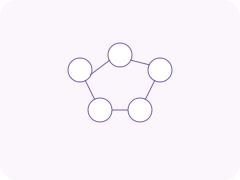
A tight inner circle of ten committed people has incalculable value for emotional support, trust, and sustained collaboration. But its capacity to provide access to new information is limited, precisely because it is a circle — everyone is connected to everyone else.
This is known as network closure. When all members of your network know each other, the network has cohesion but little information diversity. Networks with more diversity, even if of lower emotional intensity, have greater capacity to introduce you to worlds you do not yet know.
Research after Granovetter refined the model further. Ronald Burt developed the concept of structural holes: positions in a network where certain people connect groups that would otherwise have no contact with each other. Those people have disproportionate access to new information, to uncombined ideas, to opportunities that do not circulate within any of the individual groups separately.
Weak ties in practice
What Granovetter documented in the 1970s labour market has been replicated in very different contexts: the diffusion of innovations, the search for collaborators in creative projects, the detection of business opportunities.
Some concrete implications:
The former colleague you lost touch with deserves an occasional message. Not to ask for anything, but to keep the channel open. A dormant relationship has minimal maintenance cost and meaningful activation potential.
Professional events in adjacent sectors are more valuable than they appear. Not for aggressive networking, but for building acquaintances who exist in worlds different from your own.
The “do you know anyone who…?” question works better through weak ties than strong ones. Your friends already know what you are looking for. Your peripheral acquaintances are in networks that are not yours.
The diversity of your network matters as much as its size. A thousand contacts from the same sector offer less diversity than a hundred contacts from five different sectors.
How to maintain and activate peripheral connections
The risk with weak ties is that they evaporate through lack of maintenance. Unlike strong ties, which survive months of silence because of the depth of prior connection, peripheral acquaintances need occasional contact to avoid becoming strangers.
Some practices that work without feeling forced:
Share something useful without asking for anything in return. A relevant article for someone in your peripheral network, a job posting that does not apply to you but might interest them, a connection that could be valuable to them. One-sided, unprompted maintenance is the most effective over the long term.
Acknowledge milestones without an agenda. A congratulatory message on a job change or public achievement is a low-cost, high-effectiveness intervention for keeping a tie active.
Be specific when asking for help. If you need to activate a weak tie for something concrete, be direct and specific. Asking for general advice is costly for the person receiving it. Asking for something concrete and tractable makes a response more likely.
Weak ties do not replace strong ones — they complement them. A healthy network has depth in its close circles and diversity in its peripheral ones. Building that network does not require being extroverted or attending events constantly. It requires maintaining the bridges that already exist, rather than letting them fall.