Perfectionism has excellent public relations. It is presented as a sign of high standards, commitment to doing things well, attention to detail. In job interviews it is offered as a favourite weakness because it does not really seem like a weakness at all. It seems like a virtue with an excess of zeal.
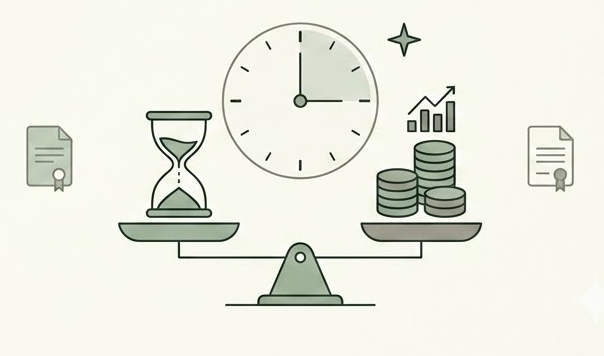
But perfectionism has a measurable cost that is rarely counted. Not the cost of doing things badly, but of not doing them on time, of not doing them at all, or of doing them so late that the context has already changed. That cost is invisible because the perfectionist always has a legitimate justification: it could still be improved.
Why Perfecting Feels Productive
The brain does not distinguish well between working on something and advancing on something. Adding one more iteration to a document, adjusting the design of a presentation, rereading an email for the fifth time before sending it: all of that activates the same feeling of useful activity. Attention is focused on the work object. Decisions are being made. Something is being improved.
What the brain does not register is the opportunity cost. While you perfect that email, twenty other tasks are waiting. While you adjust that presentation for the tenth time, someone who delivered a good version three hours ago is already working on the next project.
There is also an avoidance mechanism that disguises itself as rigour. Perfecting something that is already good enough can be a way of delaying the moment of delivering it, of exposing it to external judgment. While the work remains “in progress”, criticism is internal and controllable. The moment it is delivered, that control is lost. Perfectionism can be, in many cases, fear management disguised as high standards.
This does not mean all perfectionism is avoidance. There are tasks that genuinely require extreme care. But the tendency to perfect everything equally — an internal email with the same dedication as the annual report — reveals that the impulse does not respond to the actual requirements of the task, but to a deeper behavioural pattern.
The Cost of the Last Improvement
In economics there is the concept of diminishing marginal returns: each additional unit of effort produces less result than the previous one. In creative and intellectual work, this translates into a quality curve that rises quickly at first and flattens over time.
A first draft of a text captures 70% of its possible value. Revising it once brings it to 85%. A second revision takes it to around 92%. But getting that final 8% may require as much time as the three previous phases combined. And that last 8% is often invisible to the reader.
The problem is not that that 8% does not exist. The problem is that it carries a disproportionate price: the time you could have spent on the next project, another task, or simply recovering to work better tomorrow.
When this happens systematically, the perfectionist produces less in the long run than someone who delivers on time at a good but not maximal quality level. Not because they work less, but because they concentrate too much time in the minimum-return phase of each task. Real productivity — measured in value output delivered, not hours invested — suffers.
There is another cost that is even more silent: the work that never gets started because the internal standard makes starting feel too committing. If you have to do it perfectly, it is better not to begin until you are sure you can deliver it that way. That pattern destroys projects before they exist.
When Quality Actually Matters
The argument against perfectionism is not that quality does not matter. It is that not every context requires the same level of quality, and confusing them has a cost.
There are tasks where quality is critical and error has no margin: a medication dosage, the specifications of a structural component, the terms of a contract with irreversible consequences. In these contexts, exhaustive review is not perfectionism — it is professional diligence.
There are other tasks where quality matters but has a reasonable threshold: an executive report, a commercial proposal, a published article. Here, going beyond the reasonable threshold produces visible diminishing returns.
And there are tasks where quality barely matters because the impact is low and the work is ephemeral: an internal coordination email, a meeting note, a quick reply. Here, perfectionism is pure expenditure.
The problem is that the perfectionist brain applies the same standard to all three categories. The solution is not to lower standards across the board, but to differentiate them by task. To do that, the distinction must be made consciously at the start of each piece of work, not at the end.
The Good Enough Threshold
A practical tool against perfectionism is defining the “good enough” threshold before starting a task, not once you are already deep inside it.
At the beginning of any piece of work, ask three questions: who will see this? What level of quality do they expect or need? What is the cost of a minor error in this context? The answers set the threshold. Once defined, the goal is not to exceed it — it is to reach it efficiently and stop.
This sounds simple but requires practice because the threshold tends to move. As you advance through a task, visibility over its details increases, and with it the temptation to improve what you could not see before. The trick is to remember that those additional details you now notice are invisible to most recipients, and that their improvement rarely justifies the time invested.
An external criterion also helps. Instead of asking whether the work is perfect, ask whether it is at the level a competent professional would deliver given the available time. That reference is more useful than the internal standard, which tends to be arbitrarily high.
Shipping Before You’re Ready
There is a phrase that circulates in the software development world with much broader application: “If you are not embarrassed by the first version, you launched too late.” It is an exaggeration, but it points at something real: contact with the real world provides information that no internal iteration can replicate.
A text that gets published reveals which paragraphs generate questions, which argument fails to convince, which example the reader does not follow. A proposal that gets delivered reveals whether the approach was right or needed a different angle. A project that launches reveals whether the problem it solves is the one the user actually had.
None of that information is available before delivering. Therefore, every additional iteration before delivery is done on assumptions, not on real data. And the internal assumptions of someone who perfects are the least reliable of all, because they are systematically biassed toward the aspects of the work that matter to them — not necessarily those that matter to the recipient.
This does not mean delivering mediocre work. It means delivering good work at the right moment and improving it afterwards, with real information, if the result justifies it. That sequence — deliver, learn, improve — is more efficient than the perfectionist’s sequence: perfect, doubt, perfect more, doubt more, deliver late or not at all.
The good enough threshold is not a surrender. It is a professional criterion.