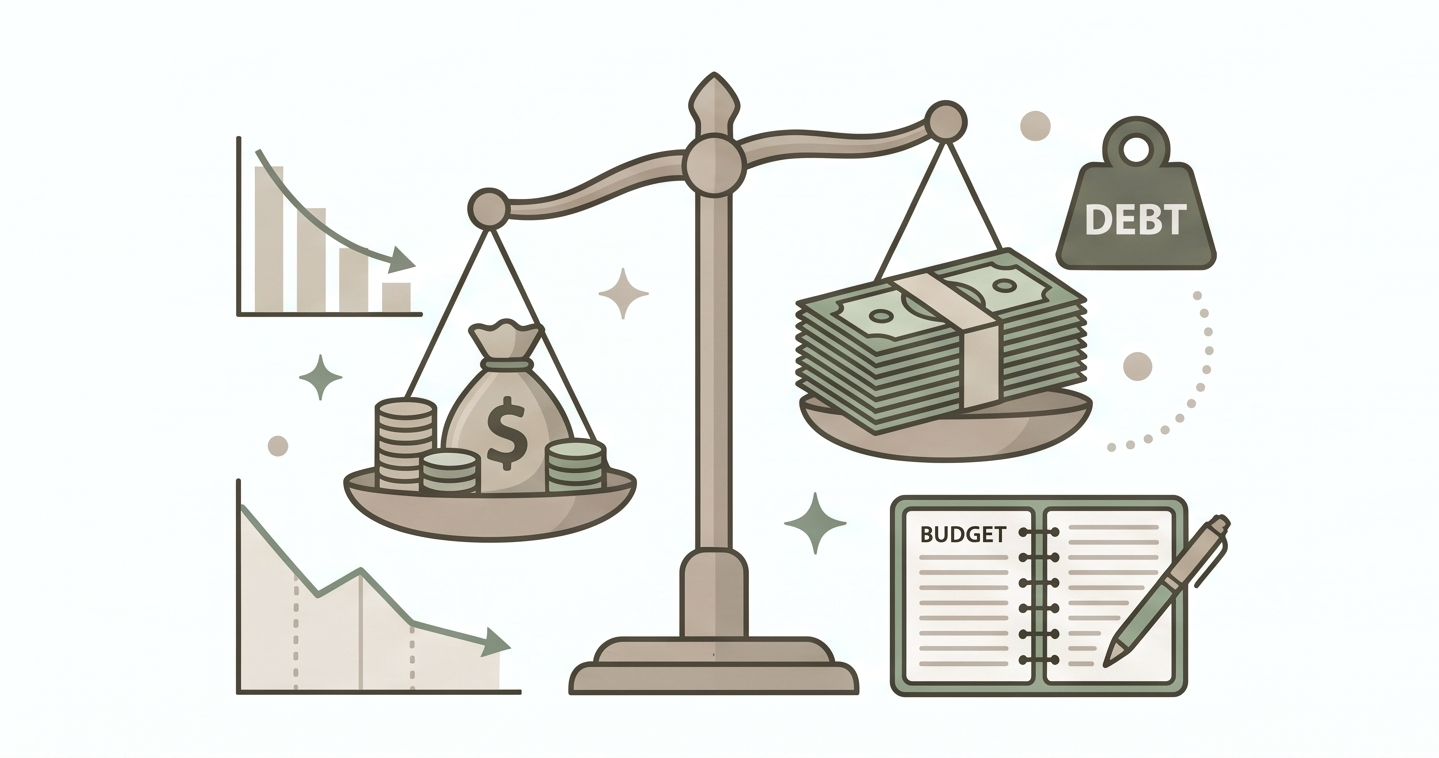
There’s a question that eventually surfaces in the financial life of almost anyone with a mortgage: I have some savings — should I pay down the loan or invest it? It looks simple but has more layers than it appears. The right answer depends on the mortgage interest rate, the time horizon, the risk profile, the tax treatment, and factors the numbers don’t capture. This article tries to give an honest answer.
The Dilemma Millions of Households Face
When someone takes out a mortgage, they sign a decades-long commitment. The bank lends a sum at a fixed interest rate, and the borrower pays a monthly installment combining principal and interest. That structure works smoothly until the borrower starts accumulating additional savings. At that point, the question arises: does it make sense to leave that money in the market expecting a higher return, or is it better to reduce the debt and the cost of interest?
Many people’s intuition leans toward paying off debt. Debt creates discomfort, and eliminating or reducing it produces immediate, tangible satisfaction. But financial intuition, when quantified, doesn’t always align with the emotional response.
In Spain, the context has shifted dramatically in a few years. Those who signed variable-rate mortgages between 2015 and 2022 did so when the Euribor was in negative territory, with effective rates between 0.5% and 1.5%. From 2022 onwards, the Euribor rose sharply and those same mortgages moved to cost between 3.5% and 5%. The calculation that was obvious in one direction flipped, and many had to reconsider their strategy.
When the Math Gives a Clear Answer
The underlying logic is straightforward: if the cost of the debt is lower than the expected return on investment, invest. If the cost of the debt exceeds that expected return, pay it down.
A concrete example: if your mortgage carries an effective rate of 2% per year and a globally diversified index fund portfolio has historically returned 7–9% per year before taxes, the mathematical decision points to investing. Every euro you use to pay down the loan “earns” you a guaranteed 2%; every euro you invest may earn 7–9%, though with volatility.
The same reasoning reverses when the mortgage rate is high. With the Euribor at 3.7% plus a 1% spread, if the effective rate exceeds 4.5%, the probability that a diversified investment will consistently beat that figure decreases, especially over short time horizons. Over five years, the market can easily be below that threshold. Over twenty years, the historical probability of exceeding it is high, but not guaranteed.
There is also a tax factor in Spain that alters the calculation: mortgages signed before 2013 carry a tax deduction on the purchase of a primary residence. If that applies to you, paying down the mortgage produces a double benefit: it reduces the outstanding principal and generates a 15% tax deduction on the amount repaid, up to the legal ceiling. That tax benefit reduces the real effective cost of the debt and makes early repayment more attractive.
The interest rate on your mortgage after taxes is the number that matters, not the nominal rate in your contract.
What the Spreadsheet Doesn’t Capture
The math is necessary but not sufficient. There are dimensions of the problem that numbers fail to address.
The emotional volatility of markets. Investing in index funds means accepting that the portfolio’s value can fall 30% or 40% in a bad year. Someone with a large mortgage and tight savings capacity may not be able to tolerate that volatility without making rushed decisions. The cost of selling at the wrong moment — out of fear or necessity — can exceed the theoretical benefit of having chosen to invest rather than repay.
The psychological security of a debt-free property. For many people, reducing the mortgage produces a sense of control and security that has real value, even if it doesn’t appear on a spreadsheet. Sleeping better because the debt is lower is a tangible benefit. It has no market price, but it exists.
Employment and income risk. If your job is unstable or your income fluctuates, reducing the monthly mortgage payment by paying down principal has value beyond the difference in interest rates. A smaller mortgage is a smaller monthly obligation, which extends the margin for maneuver if income drops. An investment portfolio may need time to recover if the market falls precisely when you need the money.
The remaining term of the mortgage. Having 25 years left is not the same as having 5. If only a few years remain, repayment reduces total cost by less, because most of the interest has already been paid (that’s how the standard French amortization schedule works). If many years remain, each euro repaid cuts far more from the total cost of the debt.
The Hybrid Strategy: Neither All Nor Nothing
For most profiles, the best answer is not choosing between repaying or investing, but defining what share of monthly savings or available capital goes to each destination.
A practical rule many financial planners use: first secure the emergency fund (three to six months of essential expenses in immediately accessible liquidity), then apply a split to additional savings that reflects both the rate differential and your risk tolerance.
If your mortgage rate is above 4%, it may make sense to direct 60–70% of additional savings toward repayment and the rest toward investment. If the rate is below 2.5%, the proportion can flip. Between those extremes, the exact split is a personal decision that blends math and psychology.
The advantage of the hybrid strategy is that it doesn’t require betting everything on a single option. You reduce debt steadily, which provides reassurance and lowers the household’s financial risk. At the same time, you maintain an investment position that benefits from compounding over the long term.
This strategy also allows you to adjust the ratio over time as interest rates, employment conditions, or the remaining mortgage term change.
How to Decide Based on Your Situation
Before deciding, three numbers are worth having clear.
The real effective rate of your mortgage. Not the nominal rate in the contract, but what you actually pay after considering any tax deduction on primary residence. If you pay 4% nominal and deduct 15% of what you repay, the effective cost of the debt is somewhat lower.
Your real investment horizon. If you might need that money in the next five years — for an emergency, a life change, any large expense — the investment horizon is not truly long and market volatility becomes a real risk. If the money can stay invested for 15 or 20 years without being needed, the probability that the market will exceed the mortgage cost improves considerably.
Your emergency fund. If you don’t have a liquidity buffer covering three to six months of essential expenses, don’t use that savings to pay down debt or invest. That money must sit in a deposit or interest-bearing account before any other decision is made.
With those three data points clear, the decision simplifies. If the emergency fund is covered, the horizon is long, and the mortgage rate is low, investing has a solid mathematical case. If the horizon is uncertain or the rate is high, paying down the mortgage (or splitting savings between both options) reduces the household’s total risk.
What doesn’t make sense is doing nothing. Leaving savings in a current account earning 0% while carrying a 4% mortgage debt, or missing a compounding opportunity, is — in opportunity cost terms — the worst of the three options.