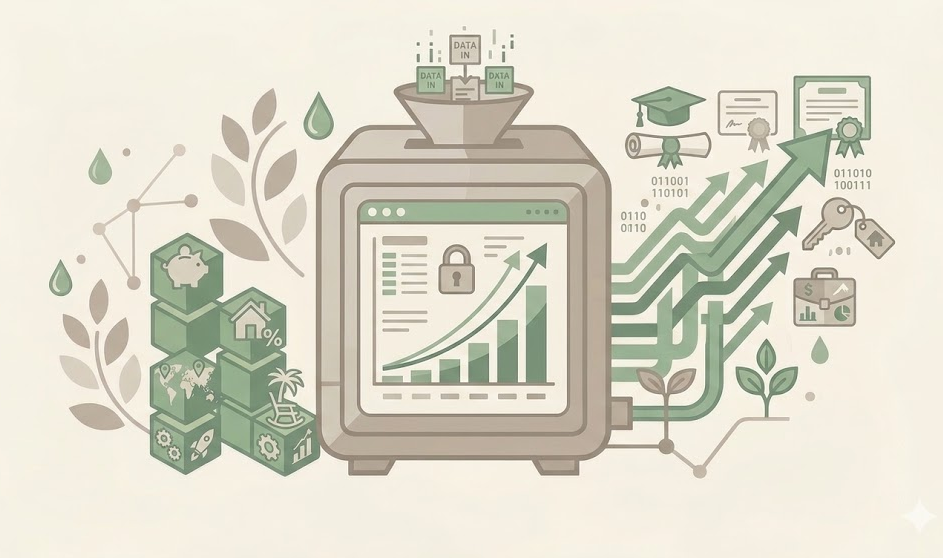
You have reached the end of the course. Seven modules, twenty-six chapters, a progression from the most basic — why money matters at all — to the most expansive: what kind of life do you want to build, and how does money serve that?
It is worth stepping back now and naming what was really being discussed throughout.
What this course was really about
This course was not, at its core, about money. It was about agency — the capacity to make meaningful choices about how you live, rather than being constrained by financial stress, ignorance or desperation into accepting whatever circumstances offer you.
Money is one of the most effective tools for expanding agency. Not the only one, not the most important one in every dimension of life, but a powerful one that is frequently misunderstood, avoided and misused. When you understand it clearly — when you see it as the tool it is rather than the goal it is often mistaken for — you can use it deliberately.
Deliberate use of money means: knowing what you spend and choosing it consciously. Having reserves that protect your decision-making under pressure. Avoiding the debt that makes every choice contingent on servicing the past. Investing the surplus so that your future options expand over time rather than contract. And planning — not obsessively, not anxiously, but with enough clarity to see the trajectory you are on and to adjust it if it is not the one you want.
None of this is about becoming rich. It is about becoming free.
Time as the finite resource
The deepest insight in personal finance is simple and rarely stated plainly: money can be replenished, but time cannot.
You can earn more money. You can lose money and recover it. The history of finance is full of people who started with very little and built substantial wealth through time and discipline. But no one has ever recovered a year they spent doing work they found meaningless, living a life they did not choose, waiting for some future moment when circumstances would finally be right.
This is what financial independence actually buys: not a beach and a cocktail. The ability to say no. The ability to choose work because it matters to you, not because you need the salary. The ability to take a risk — change careers, start something, spend a season doing something unpaid and important — without the choice being governed by fear.
For some people, that moment of freedom comes at 35. For others, 50. For others, the goal is not retirement at all, but the ongoing knowledge that their financial position is solid enough that their choices are genuinely choices — not compulsions.
The three stages of financial freedom
Financial freedom is not binary. It builds in stages, and each stage is worth recognising and celebrating.
Stage one: financial stability. You have an emergency fund. You are not accumulating new consumer debt. Your basic expenses are covered and your income exceeds your spending. This sounds modest, but it is genuinely life-changing for people who have lived without it. Financial stability removes the acute stress of scarcity and creates the cognitive space to think about the future. Many people spend their entire lives at stage zero, one bad month from crisis. Reaching stage one is not a small thing.
Stage two: financial security. Your investments have grown to a level where the returns are meaningful. You could sustain a period of unemployment without crisis. You have choices about where you work, not just whether you work. The financial future is on a positive trajectory that does not require perfect execution of every decision. Stage two is where freedom begins to feel real — not as a future possibility but as a present reality.
Stage three: financial independence. Your investment portfolio generates enough income to cover your expenses without your labour. You work if and because you want to. Your time is yours to allocate according to your values rather than your financial necessity. This is the FIRE destination for those who pursue it — but it is also simply the logical endpoint of decades of compound growth and consistent saving, available to most people who start early enough and persist.
Most people can reach stage one within a year or two of focused attention. Stage two takes longer — typically five to ten years of consistent practice. Stage three is the horizon: a decade or more away for most, but calculable, and therefore pursuable.
The habits that persist
What makes the difference between reaching these stages and not reaching them is not intelligence, income, or financial sophistication. It is a small set of habits, practised consistently:
Look clearly at your money. Know what comes in. Know what goes out. Review it regularly. Clarity is the prerequisite for everything else.
Spend deliberately. Not less than you want — deliberately. Know why you are spending what you are spending. Let your spending reflect your values rather than your impulses or your defaults.
Pay yourself first. Save before you spend. Automate it. Build the structure that makes financial progress the default rather than the exception.
Invest consistently. In diversified, low-cost index funds, over long time horizons, without reacting to market news. Boring, persistent, effective.
Avoid destructive debt. Never carry high-interest consumer debt. If it exists, eliminate it before investing. Debt at 20% costs more than any investment can reliably earn.
Keep learning. The concepts in this course are foundations, not ceilings. Tax laws change. New products appear. Your circumstances evolve. Financial literacy is an ongoing practice, not a qualification you earn and store.
A final word
The goal of financial education is not to produce people who think about money all the time. It is to produce people who think about money enough that it stops being a source of anxiety and starts being a background condition they have under control — leaving the foreground of their attention free for the things that actually matter: the people they love, the work that is meaningful to them, the experiences that make a life feel well spent.
Money, at its best, is invisible in that picture. It is the foundation that makes everything else possible without demanding constant attention. Getting it right frees you to stop thinking about it.
That is what this course was for. What you do with the time you have bought is entirely up to you.