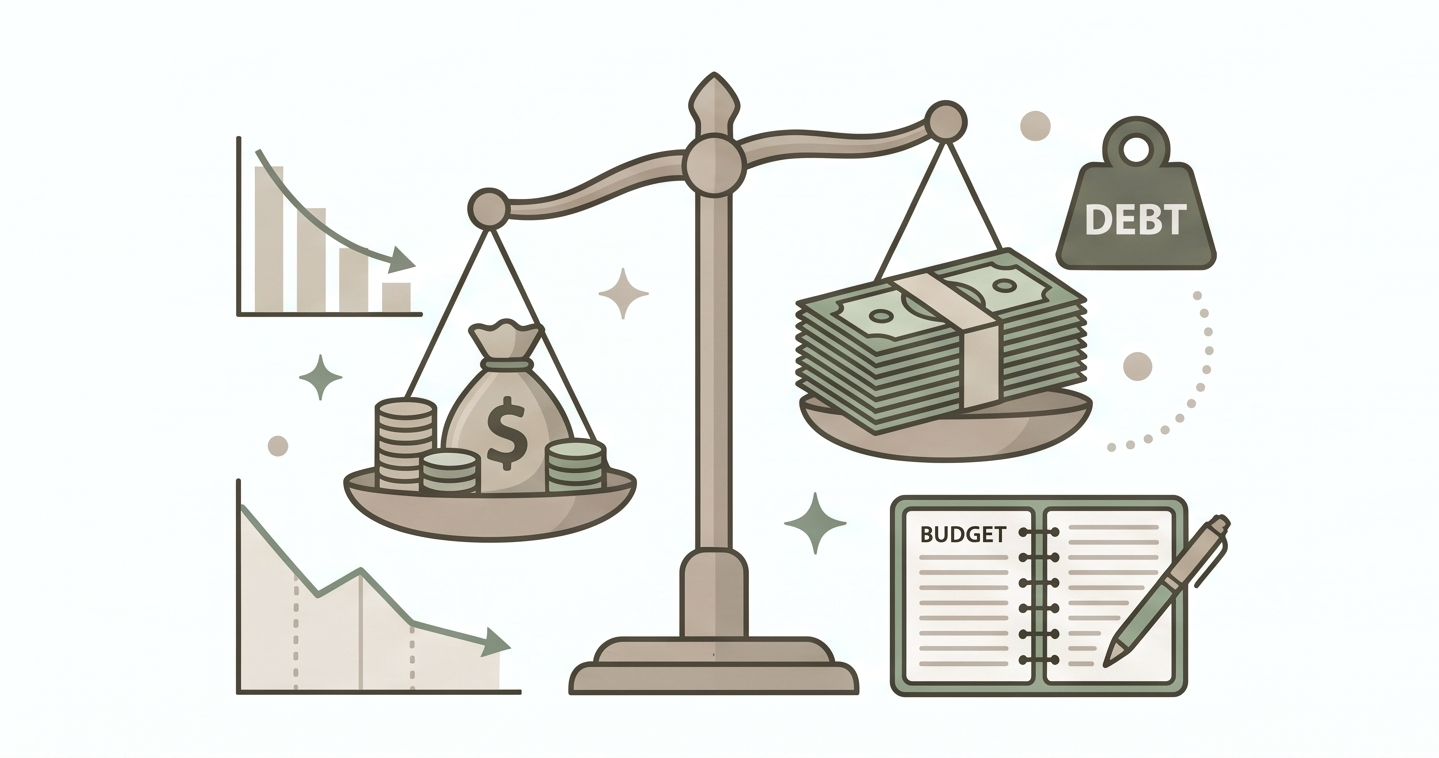
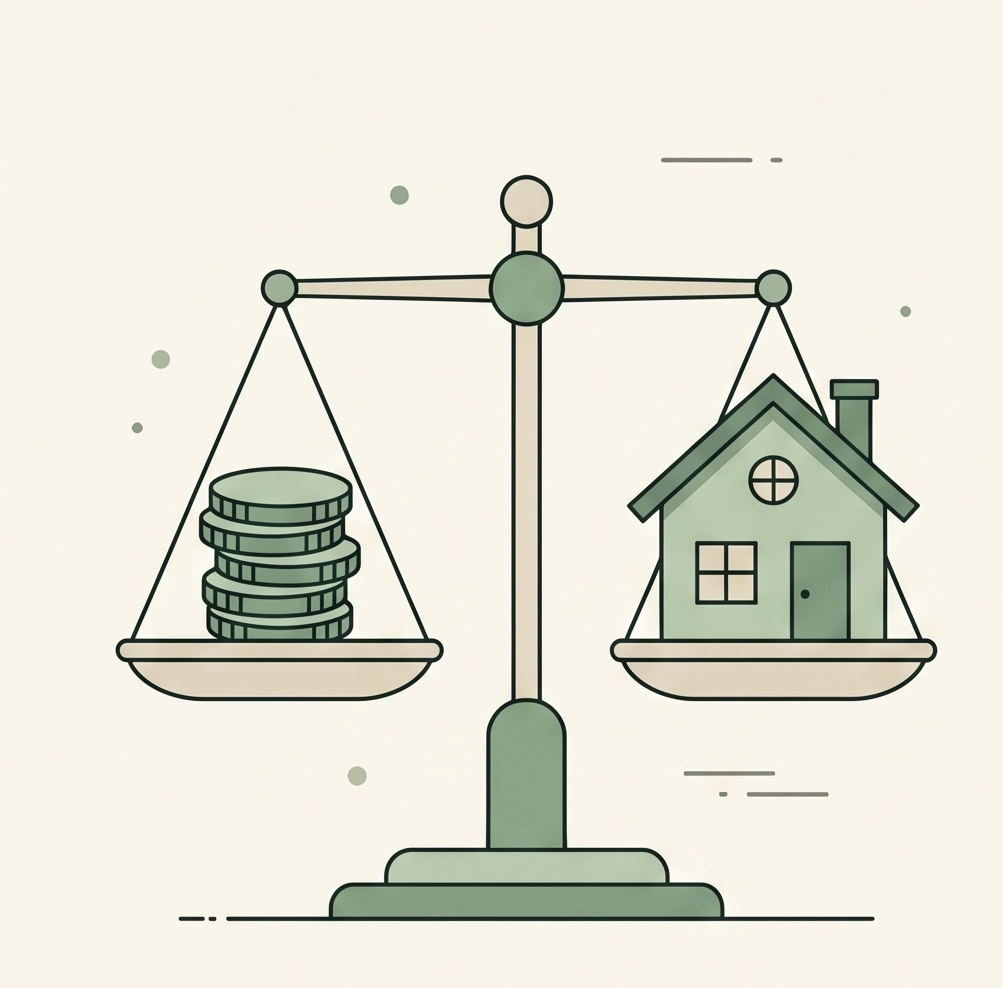
Sooner or later, anyone who starts getting their personal finances in order faces the same question: should I keep paying off debt before investing, or can I do both at the same time? The intuitive answer usually falls into one of two extremes: “pay everything off first” or “the market always wins, start now.” Neither is correct as a universal rule. The real answer depends on several factors that can be analyzed with some precision — though the final decision also includes something the numbers don’t capture: the emotional weight of owing money.
The Dilemma That Paralyzes Most
The tension between debt and investing is real, and it has mathematical roots. When you have a debt at 8% annual interest and choose to invest that money instead of paying it down, you are betting that your investment will return more than 8%. If the market gives you 7%, you have lost money in net terms — even if your brokerage statement shows a gain.
At the same time, if you have a mortgage at 2.5% and decide not to invest until you pay it off, you are probably giving up decades of compounding returns in exchange for avoiding a cost the market regularly beats over the long term. The decision not to invest also has a cost, even if it doesn’t appear on any account statement.
The most common mistake is treating all types of debt as if they were equivalent. They are not. Debt at 25% — a revolving credit card — and debt at 2% — the average Spanish mortgage over the past decade — are financial products that work in opposite directions inside your household economy. Conflating them leads to decisions that make no sense in either direction.
Interest Rate: The Boundary That Decides Everything
The core logic is straightforward: if the cost of your debt is higher than the expected return on your investments, the rational move is to pay first. If the cost of your debt is lower than that expected return, investing in parallel can make sense.
The problem is that the future return on an investment is not known in advance. What you do know precisely is the interest rate on your debt. That is why the comparison has to be made against reasonable benchmarks, not optimistic scenarios.
Historically, the global stock market has returned between 7% and 10% annually in nominal terms over very long periods — more than twenty years. After stripping out inflation, that real return falls to the 4%–7% range. Those are the figures that make sense to work with.
From there, a practical reference emerges:
- Debt above 7%–8%: paying it off first is almost always the mathematically stronger choice.
- Debt in the 4%–7% range: grey zone. It depends on time horizon, risk tolerance, and individual circumstances.
- Debt below 4%: investing in parallel usually makes sense, especially over a long time horizon.
This is not a rigid rule, but it is a useful guide for escaping the paralysis many people get stuck in indefinitely.
When Debt Doesn’t Stop You from Investing
Some types of debt coexist perfectly well with an active investment strategy. The clearest example in Spain is a fixed-rate mortgage taken out in recent years. If you have a mortgage at 2.5% or 3%, and you can invest in a global index fund with a reasonable expectation of 6%–7% annual returns over ten or twenty years, the math clearly favors investing while you make your regular mortgage payments.
The same applies to student loans at low rates or subsidized vehicle financing. These are low-cost debts that should not halt a long-term savings strategy.
In these cases, making extra early repayments on the loan is, in practice, earning a return equal to the loan’s interest rate. If that rate is 2%, you are “earning” a guaranteed 2%. That is not bad, but you are giving up the possibility of 6%–7% in the market over decades. The difference, compounded over twenty or thirty years, can be very substantial.
The caveat is obvious: historical market returns do not guarantee future performance. If your tolerance for volatility is low or your time horizon is short, the comparison shifts dramatically.
When Paying Off First Is the Right Move
Expensive consumer debt changes the analysis entirely. Credit cards that allow deferred payment typically charge between 18% and 26% per year. Quick online loans can exceed 30% APR. No reasonable investment strategy competes with those numbers.
With expensive debt, every euro you do not repay is growing against you at a rate the market rarely matches — and never reliably. The only financially intelligent move in that scenario is to eliminate that debt as quickly as possible. Investing while carrying 22% debt is not financial optimism; it is mathematically a net loss.
You also need to consider the rigidity of invested capital. If you will need that money within one or two years to meet a debt that comes due, putting it in equities is a planning error. Stock market investing requires a long horizon; if you do not have one, a term deposit or high-yield savings account is a more appropriate choice than taking on market risk in the short term.
The Three-Priority Rule
A practical way to sort out the problem is to establish a system of priorities before deciding where each available euro at the end of the month should go.
First priority: the emergency fund. Before making extra debt payments or investing a single euro, you should have three to six months of expenses in a liquid, safe place. Without a cushion, any unexpected expense sends you back to square one or forces you to take on new debt, undoing any progress you have made.
Second priority: eliminate expensive debt. Any debt above 7%–8% should be paid down actively before investing in markets. The return on paying off that debt is the interest rate you stop paying — a guaranteed, market-risk-free return.
Third priority: invest and pay down in parallel. Once the emergency fund is in place and expensive debt is gone, it makes sense to split your monthly savings capacity between paying down lower-rate debt and investing for the long term. The exact proportion depends on your situation: time horizon, risk tolerance, and specific goals.
This system does not mathematically maximize returns in any single direction, but it creates a robust structure that holds up across different economic scenarios and that most people can sustain over time without anxiety.
What the Numbers Don’t Measure
The math can tell you whether paying off debt or investing makes more rational sense. But there is one factor no spreadsheet captures precisely: peace of mind.
For some people, knowing they have outstanding debt — even cheap debt — creates a level of stress that affects other areas of their life. In that case, reducing or eliminating the debt may be the smarter decision, even if it is not the most profitable one on paper. Financial equanimity has real value that does not appear in any simulator.
For others, low-cost debt is a neutral financial tool to be managed with detachment. They know their 2% mortgage does not prevent them from building wealth, and they act accordingly without letting the debt shape their investment decisions.
Both positions are valid. Personal finance is not just mathematics — it is mathematics applied to people with different risk tolerances, different sources of anxiety, and different life horizons. The best plan is not the one that maximizes expected return; it is the one you can sustain over time without it costing you sleep.
The question worth starting with is not “which is more profitable?” but rather “what effect does owing money have on my well-being?” The answer to that question is worth at least as much as the interest rate.