One of the questions that most paralyses people when they start building a knowledge management system is: how do I organise it?
The question usually comes with a particular anxiety: the fear of organising badly and having to redo everything afterwards. That anxiety is understandable but, for the most part, unfounded. The organisation of a personal system is not irreversible; it is adjustable. What is worth being clear about is what options exist and what consequences each one has.
The problem with organising without criteria
Most people organise their notes the same way they organise their physical desk: reactively, putting things where they seem to fit at the moment, without a conscious system behind it.
The result is usually a structure that makes sense to the person who created it at that moment, but which is incomprehensible to that same person three months later. And if you cannot find what you saved, the system has failed in its fundamental purpose.
There are three main organisation models, each with its own logic.
Folders: hierarchical organisation
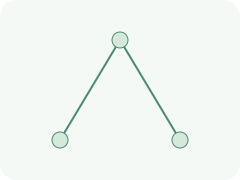
Folders are the most familiar model. Information is organised in a hierarchy of containers: a folder contains subfolders that contain files. It is the model of the operating system, most file managers and many note managers.
Its advantages: it is intuitive, it is predictable, and it makes finding things easy when you know approximately where they are.
Its limitations: reality rarely fits into perfect hierarchies. A note about productivity related to finance and also relevant to a writing project — which folder does it go in? The usual solution is to duplicate or create “miscellaneous” folders that end up becoming catch-all drawers.
Folders work well when knowledge has a clear and stable thematic structure, and when each element unambiguously belongs to one category.
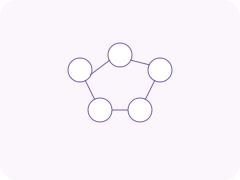
Tags: organisation by attributes
Tags allow you to assign multiple attributes to an element without needing to choose only one. A note can have the tags “productivity”, “finance” and “currently-reading” simultaneously.
Its advantages: total flexibility. An idea can belong to multiple contexts without duplication. It facilitates searching by combining attributes.
Its limitations: without discipline, the tag system becomes chaos. Over time, similar tags proliferate (“book”, “books”, “reading”, “to-read”) and coherence is lost. Tags also require active maintenance effort that folders do not need.
Tags work well as a complement to another organisation system, not as the main system.
Contexts: organisation by use
The third model is the least intuitive but the most powerful: organising by context of use, not by topic or attribute.
The question is not “what is this about?” but “when and for what will I need this?”. Information you need for an active project goes in a different place to a reference you might need someday, even if they are on the same topic.
This is the principle behind the PARA method, which we will look at in the next chapter: projects, areas, resources and archive are contexts of use, not thematic categories.
Its advantages: it orients the system towards action, not storage. What is most accessible is what you need most now. It reduces friction when retrieving relevant information.
Its limitations: it requires a more sophisticated decision moment when organising. Additionally, the usefulness of the same information can change over time, requiring periodic reviews.
How to combine them
The three models are not mutually exclusive. Most effective systems use a combination:
- Contexts as the main structure: the first level of organisation is by use (projects, areas, resources, archive).
- Folders or thematic categories as secondary organisation within each context.
- Tags as an additional layer to facilitate cross-cutting searches.
In the next chapter we present the PARA method in more detail: a concrete proposal for applying context-based organisation in a practical and sustainable way.